.jpg)
In 2019, ECMWF held a workshop which successfully brought together past and future field campaigns with model developers and data assimilation experts. As more than 5 years have now passed since this workshop, one can ask the following questions: “were the presented campaigns successful?”, “what new science has been learnt?”, “what impact have the data had on the forecast model and data assimilation development?”, and “what are the remaining gaps needed to be filled by campaigns?”
In general campaign/field experiments can serve the community in several ways by:
1. providing observations in real-time to be assimilated into the forecast systems to improve current operational forecasts
2. giving opportunities for diagnostic studies and new physical insights about the Earth system
3. providing observations to guide model development by identifying systematic errors in models and insights on areas of potential improvement
4. providing observations to help validate/calibrate satellite platforms
5. giving guidance on the design of future observation systems
In January and February 2026, several campaigns – AR Recon, SAFARI, NAWDIC, PONEX and NURTURE – will take place across the middle and high latitudes of the northern hemisphere. Although these campaigns have their own specific aims, their observations provide a unique opportunity to investigate the potential impact of the Global Atmospheric River Reconnaissance Program (GARRP); specifically, to evaluate whether the addition of multiple conventional observing platforms across the northern hemisphere could increase weather forecast skill. Running up to these campaigns in 2026, the World Meteorological Organization (WMO) World Weather Research Programme (WWRP) organised and led a small working group bringing these campaigns and some other stakeholders together to find possible synergies.
This workshop at ECMWF will be formed of two separate – yet overlapping in scope – workshops.
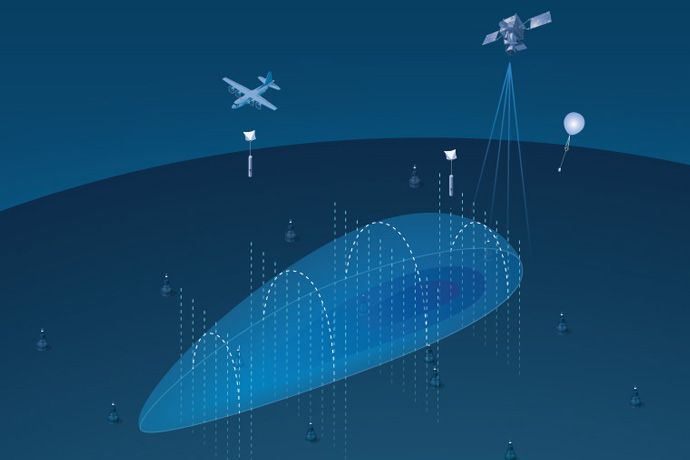
1. The 2026 Atmospheric River Reconnaissance (AR Recon) Workshop, providing the latest updates and science from the 2026 season. AR Recon uses U.S. Air Force Reserve Command WC-130Js and the NOAA G-IV aircraft to carry out reconnaissance missions collecting high-density flight level observations and atmospheric profiles using dropsondes. The program has also partnered with the Global Drifter Program, led at Scripps Institution of Oceanography by the Lagrangian Drifter Laboratory, to deploy 429 drifting buoys with pressure sensors since 2018. AR Recon also supports innovative technologies such as Airborne Radio Occultation (ARO), and partners with private sector companies like WindBorne Systems to carefully coordinate data collection for maximum value.
2. The 2nd observational campaigns workshop for better weather forecasts, focusing on the northern hemisphere campaigns during January and February 2026. The most appropriate ways to coordinate related diagnostic work and forecasting experiments will be discussed.
The workshop will also invite back the campaigns from the 2019 workshop to hear about the outcomes and the lessons learnt in the activities after the campaigns. We will also discuss how to maximise the uptake of the campaign data in the scientific community. Finally, we will discuss the future gaps and how campaign data can best serve training of machine-learning models.
Call for abstracts
We invite abstract submissions for oral and poster presentations for both workshops. If you wish to make a contribution, please complete the abstract submission form before 30 April 2026.
Attendance
The workshops are open to experts involved in AR Recon and field campaigns. While the primary focus is on in-person participation to encourage discussion and collaboration, all talks will also be livestreamed for those who wish to follow the sessions online.
Advance registration is required. If you wish to attend, please complete the registration form before 14 May.
Timeline
19 January 2026: Registration and abstract submission open
30 April 2026: Abstract submission deadline
7 May 2026: Notification of poster abstract acceptance
14 May 2026: Registration closes