Location: The Danish Meteorological Institute (DMI), Sankt Kjelds Plads 11, DK-2100 Copenhagen, Denmark (primarily physical event though the presentations will be livestreamed)
Event time: 10th of June 1 pm to 11th of June 3 pm
Global and regional reanalysis products provide spatio-temporal and inter-variable coherent meteorological data for the atmosphere (and beyond). Everybody who are in need of long-range consistent and gap-free timeseries for monitoring the past climate use reanalysis products. The Arctic is the area warming most rapidly. It includes steep glacier-carved topography requiring high resolution models. With 2.5 km resolution the pan-Arctic regional reanalysis provides this at an unprecedented level.
This Copernicus Arctic Regional Reanalysis (CARRA2) workshop is a part of the Copernicus Climate Change Service (C3S). Historically the CARRA Arctic regional reanalysis dataset provided high resolution regional reanalyis data for two European domain of the Arctic region. The data is available in the Copernicus Climate Data Store (CDS) at https://cds.climate.copernicus.eu/datasets?q=carra from 1991 onwards with 2-3 months delayed timely updates.
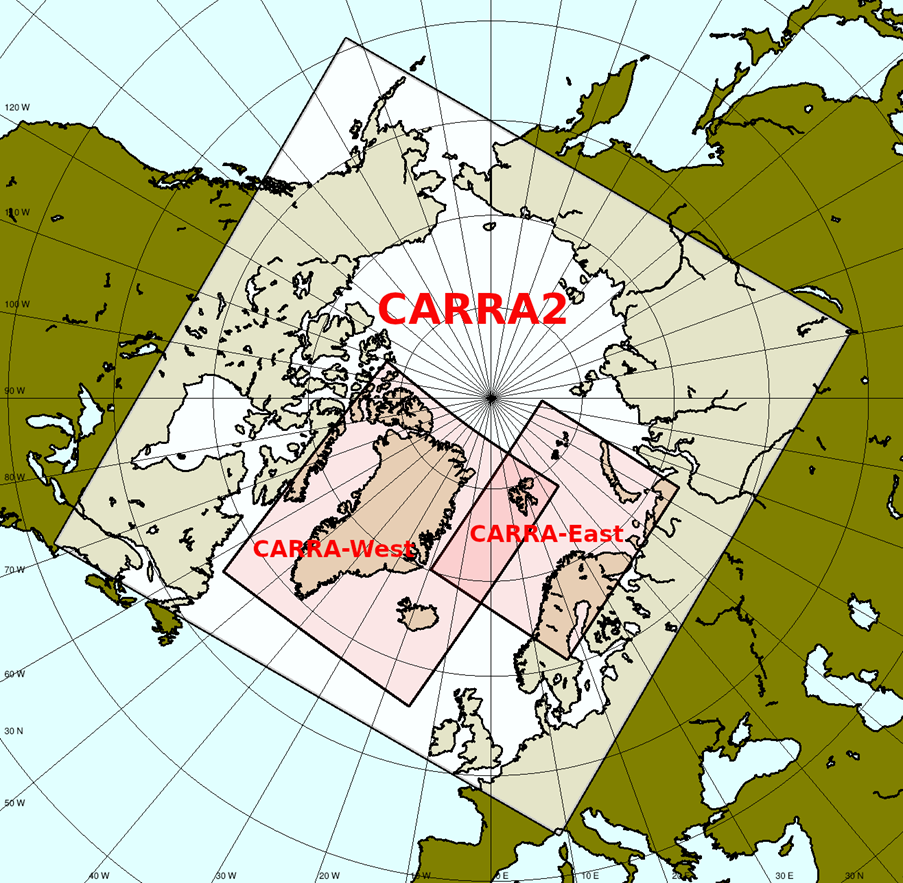
The new CARRA2 data is a pan-Arctic dataset, i.e. it covers the entire Arctic and surrounding areas. It will be available from September 1985 to present with monthly updates having a latency of less than three months. At the moment 24 years of data in 8 three-year batches is published in the Coperncius Climate Data Store (CDS). This will be soon extended first to a complete dataset until the end of 2025 and then beyond. See the available data: https://cds.climate.copernicus.eu/datasets?q=carra2. CARRA2 is produced in 2.5 km horizontal resolution using the HARMONIE-AROME weather prediction model.
Workshop themes
This workshop will first introduce the CARRA regional reanalysis family and particularly the CARRA2 system and dataset, how it was made and its validation against observations. The added value of the regional reanalysis compared to the global ones will be highlighted. Users will have also the opportunity to present their applications and experiences of CARRA and CARRA2. The set-up of the workshop will foster open discussions with the service providers and (potential) users to understand their needs and also possible shortcomings in CARRA products, which will help to define further development directions.
Planned presentation sessions (a poster session will be held separately:
Session 1: Introduction
Session 2: The details of CARRA(2)
Session 3: Use cases - examples by the users
Session 4: Discussions on user requirements