Overview
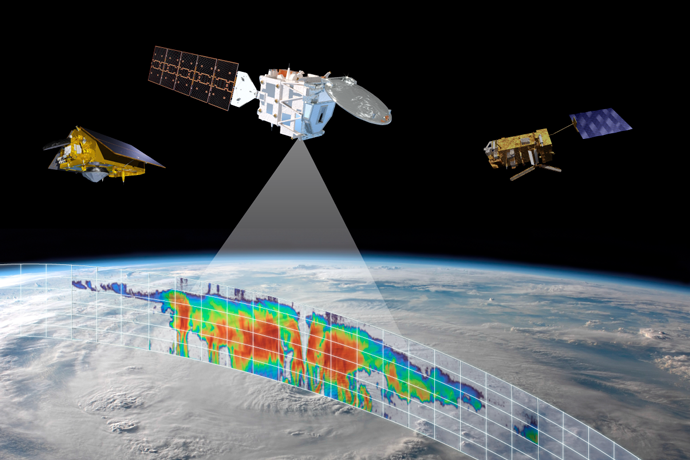
Cloud and precipitation are some of the most important parameters in any forecast, yet they remain challenging to observe, model and predict. Our main source of observations is satellite measurements of the Earth's thermal radiation, reflected sunlight, and backscattered radar and lidar. Cloud and precipitation particles interact with this radiation through thermal absorption and scattering, which is strongly dependent on the shape, size and composition of individual cloud particles, and varies strongly with frequency. From this highly indirect information, we can only infer profiles of cloud and precipitation by combining these observations with models of atmospheric dynamics, cloud, precipitation and radiative transfer. But these models remain simplified, incomplete, and prone to systematic error. If we could reduce these errors, cloud and precipitation forecasts could be much improved. Therefore, the challenge in using cloud and precipitation observations is not just to use them to initialise forecasts, but to use them to improve the models themselves.
Through a series of invited talks, this workshop will first review the state of the art in using cloud and precipitation observations, from the satellites to forecast and everything in between. Working group discussions will then try to inform future developments, considering questions such as:
- Which cloud and precipitation observation types need more development, considering both future missions and existing data that is insufficient or under-exploited?
- How can we combine information from active and passive observations, and from spectral regions from the microwave to the solar, to best effect?
- How do we start inferring not just cloud and precipitation parameters, but equations and even models, from the observations?
- What developments in physical modelling and data assimilation are needed to make better use of these observations?
- How can machine learning and AI help?
Attendance
This workshop will be held in-person only and attendance is by invitation. If you have received an invitation and would like to attend, please complete the registration form before 28 September 2026.
If you would like to be considered for an invitation, please contact us.